Self-Narrative and Self-Deception
Defending JacobSelf-Narrative and Self-Deception is the novel’s account of how identity and judgment are shaped by the stories people tell about themselves and others. The concept links Andrew Barber’s omissions before the grand jury to his retrospective recognition that he had mistaken courtroom success for justice. It also illuminates the trial’s competing narratives: Logiudice tries to make Jacob’s case legible through a single, forceful explanation, even as the evidence leaves its central question unresolved.
The Grand Jury and the Problem of Omission
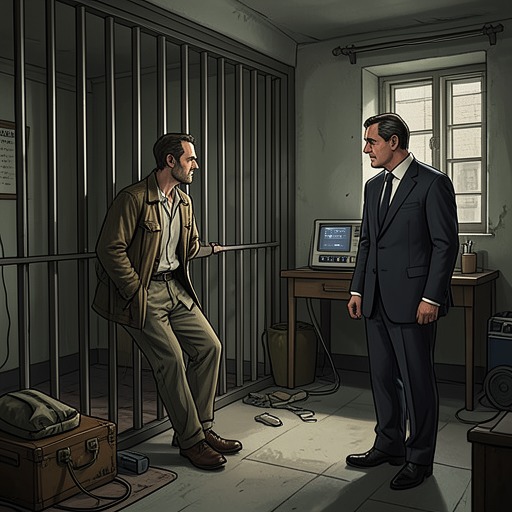
At the grand jury, Andrew is identified in the spare form of a proceeding: asked to state his name, he answers, Andrew Barber. The institutional exchange frames a longer interrogation over whether a truthful account can still mislead through what it leaves unsaid. Logiudice does not establish that Andrew made a false statement. Instead, he distinguishes between saying something untrue and withholding relevant parts of the story.
When Logiudice accuses Andrew of having spent decades forgetting who he was and where he came from, he casts Andrew’s self-presentation as a story told both to himself and to others. Andrew replies that he never said anything that was not true. Logiudice answers that he left things out, then points to the tension in asking the grand jury to believe every word. Andrew does not respond. The silence does not settle whether his account is false; it exposes how incompleteness can become a form of self-protection and how a witness’s credibility depends on more than the literal truth of individual sentences.
The Story Andrew Told About Justice
Andrew’s retrospective account makes the same issue personal. He describes himself as a prosecutor who preferred trying difficult homicide cases to choosing only likely winners, contrasting his approach with Logiudice’s. Massachusetts required murder cases to go to trial, a rule Andrew associated with the former capital stakes and the prohibition on shortcuts. He once saw this structure as an opportunity: if every case had to be tried, he could distinguish himself by winning even the weaker ones.
The story Andrew told himself was that winning meant justice had been served. He recognizes that this belief intoxicated him in Jacob’s case, where his confidence before trial seemed, in hindsight, disconnected from reality. The change is not simply from confidence to regret. Andrew identifies the narrative mechanism that sustained his confidence: he had made his professional identity depend on the conviction that he could make things turn out right in court. His own account therefore becomes evidence against the certainty it once expressed.
The Trial as a Contest of Stories
The trial makes narrative construction explicit. Logiudice’s instruction to himself is that facts alone are insufficient: the jury must be given a story that answers what the case is about, condensed into a phrase that jurors can carry into deliberations. He offers the phrase that Jacob “snapped,” turning a disputed explanation into a simple causal script. The account organizes the case around a supposedly lethal temper and a moment when ordinary teasing pushed Jacob too far.
That script depends on selecting and arranging details. Logiudice presents Ben Rifkin as an ordinary fourteen-year-old, neither saint nor finished person, while describing him as handsome, popular, and unlike Jacob, whom he characterizes as a lonely outsider. He then places a knife and an idea in Jacob’s possession as Jacob set out for Cold Spring Park on April 12, 2007, and asks what trigger converted a fantasy into an act. The closing claim that the trigger may never be known reveals the gap inside the prosecution’s story: its vivid account of motive is built alongside acknowledged uncertainty about the motive itself.
Andrew recognizes Logiudice’s persuasive technique even while rejecting its certainty. He calls the prosecutor’s performance magnificent but regards the claim that Jacob simply snapped as unsupported. He also observes that a motive is not a legal element in the same way it is a psychological demand for jurors: they want an explanation for what happened. Logiudice supplies theories and probabilities, including “murder genes,” rather than a confirmed answer. The trial thus shows how a coherent story can satisfy the desire for explanation without resolving the facts that remain unclear.
Repeated Frames and Unsettled Knowledge
The novel’s documentary and retrospective forms keep the reader aware that accounts are shaped by their occasion. Andrew appears as a named witness in grand-jury proceedings, recognizes a document identified as a letter from Dr. Vogel to defense lawyer Jonathan Klein, and recounts the arrival of an email linking him to a newly created Facebook group. At another point, he answers a late-night call in his old commanding voice, identifying himself as Andy Barber. These moments place personal narration beside hearings, documents, online messages, and habitual professional performance; none by itself supplies a complete account of events.
Across these forms, the distinction between a true statement and a complete story remains consequential. Andrew’s certainty about his own integrity is tested by the question of omission; his confidence in prosecutorial justice is revised by his experience of Jacob’s case; and the prosecution’s compact explanation of “snapping” strains against the absence of a settled trigger. Self-Narrative and Self-Deception names not a simple accusation that everyone lies, but the more difficult possibility that people can speak truthfully while relying on stories that conceal what they cannot explain.